|
|
||
| |
||
|
(from March 2011 "Dirty
Knees" newsletter.) this photo is from late May 2010. In that very early spring, lots of warmer than usual April and May temperatures brought along the dwarf Iris, Muscari, and bigroot Geranium, but this freak dusting of snow in late May won't harm plants adapted to the cool growing conditions of spring. A day or two later they perked themselves back up and carried on. Freak super warm weather though would have sent them packing up their flowers early . Spring bloomers NEED cool weather to bloom well - they're adapted to the vagaries of Mother Nature and are used to getting dumped on!
|
||
|
February 25th, 2011 DIRTY KNEES, Evelyn Wolf, Garden Consultant I can’t seem to decide what to call this newsletter. I started out with “Dirty Knees”, and then switched to “Outside My Window” to tie in with the short update I try to do monthly on my web site. I feel pulled back to using “Dirty Knees” though. It succinctly delivers the image of what real gardening is about – close observation of the fascinatingly detailed and ever changing natural life that can only be appreciated up close – down on our knees with fingers in the living earth, nose in the heart of a blossom, and eyes close enough to glimpse the retreating tail of a worm or the intricate details of a plant and all it’s parts. “Outside My Window” is a phrase that evokes the appreciation of a garden from afar. Of course, this is our end goal – a beautiful garden to delight and admire, but the pleasure of the process - the gardening itself - is something quite different. “Gardening” isn’t the achieving of an end goal, but the journey there. The lessons that working together with nature teaches, is open to all who take the time to observe closely – down on our knees in the garden with all of our senses on alert, to learn from the undeniable insistence of the natural forces at work in a garden. So that’s it then – “Dirty Knees” it is! And, as the new gardening season approaches, I’d like to say – Cheers, to dirty knee owners everywhere! A clear sign that you too participate in the wonder of the journey, and are just as itchy as I am to see spring arrive! Evelyn The “to-do” list for early March – Anything you can get done now, before the frantic pace of April/May begins, is a bonus! Perennials aren’t even out of the ground yet, but there are lots of things you can get out of the way now. If the ground is still frozen - all the better, since you won't do any damage to the soil or any plants you may accidentally step on. ~ Coming up first is shrub pruning. While anytime during the winter dormant season is fine for shrub pruning, it’s certainly more pleasant waiting for a warmish late winter day when the snow is almost gone. It might be tempting to wait for a really warm day in spring, but you want to get out there before the ground thaws so you don’t make a muddy mess of the newly thawed ground. There’s nothing worse for soil than trampling on it when it’s saturated with moisture - texture and porosity is irreparably damaged. If your soil is thawed already before you climb into the garden where the shrubs are, lay a board down to stand or kneel on. Pruning at any time should always focus is on the 5 D’s – branches that are dead, damaged, diseased, defective, and desirable. (There are still 3 spots left in our Stop the Torture!: Shrub Pruning Workshop March 30th, where you’ll learn the basic rules for determining when and how to prune each shrub in your garden correctly.)~ The job of cutting back ornamental grasses can be done now. They’re an essential part of an all season design for winter interest, but by now they’re looking pretty tattered. With few exceptions (perhaps Carex), they should all be cut back to a few inches up from the ground before any of the new season’s growth begins. Don’t cut right down to the ground – this will damage the crown on many of the true grasses. (Put April 11th on your calendar and attend our Ornamental Grasses seminar! Lots of different grasses for different sun/shade situations, and how to care for them.) ~ Next of course is dealing with the messy plant debris. After the snow melts and before anything starts greening up is the ugliest phase of a perennial garden’s life. More than at any other time, this is when patience is a virtue though! Along with your plants, worms are also stirring from their winter dormancy and looking for food – all those dead leaves. Leave as much as you can right where it is! Cut back the gawky stems and anything particularly unsightly, but instead of raking and bagging it up, crush or snip into pieces and drop it right back onto the garden soil. When you’re done, it will look much neater but you’ll likely still have the temptation to pull out the rake and just get rid of it all. Turn away from what may look messy right now for just a few weeks and between the worms and the emerging plants, it will all magically disappear from sight. This isn’t about being lazy, this is about leaving as much natural organic matter as possible to feed the worms and nourish the soil. Happy Spring everyone! Evelyn |
||
|
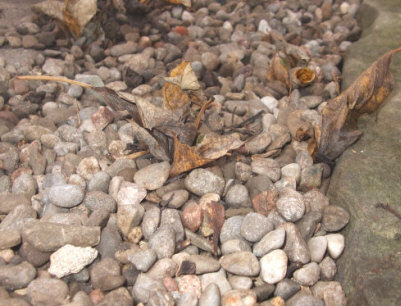
from my "Living Earth" seminar on healthy organic soil. Look closely at the ground in early spring, where last year's organic debris lies. Are there any pieces half in and half out of the ground? That's worms at work, pulling down organic debris into the soil ecosystem where there's a whole other living world ticking away! Don't rake away all this "mess" - leave it right where it is for the worms to feed on and thereby enrich your soil. A lot easier and cheaper than buying compost or other raw material each year! Clean away the most unsightly stuff, and leave as much as you can. Plants will have no problem growing up through this organic debris mulch. Evelyn |
||
|
Outside My Window,
May, 2010
rain we did have, fell
mostly during the first week. Here now, at the end of
what is supposed to be the wettest month of the year, the
ground is already so dry that some gardens already need
watering attention. We can apparently blame (or credit,
depending on your point of view), a lingering El Nino climate
pattern.
Click here for the full stats report article in Friday’s
Tor. Star.). We’ve experienced drought conditions before, but usually during the mid summer months. The repercussions of a dry spring though is much more challenging for our garden plants. Any of you who have taken my gardening class in the past will perhaps remember that I call April and early May the “Zoom zoom” period in a plant’s annual cycle, when from one week to the next they rush to put out maximum leaf growth to sustain them for the season. They need a lot of moisture to do this – more than at any other time of the season. In response to extremely less than adequate moisture, most of the larger perennials will likely be dwarfed this year. They’re unlikely to die just because of inadequate water, but they’ll hunker down and put out less growth in a survival adaptation response. Not always a bad thing though - tighter, shorter plants means less flopping and in some drought loving plants, more blooms. Each gardening season's weather patterns has it's pros and cons. They're predicting a drier than usual summer, but I'd rather deal with drought than all the excess rain and cool temperatures we had last year where plants had too much of a good thing and grew tall and fat with all the water and just flopped about as a result. Cheers! Evelyn |
||
|
Outside My Window,
April 7th, 2010 I keep my own temperature and weather records
each March/April to monitor the subtle changes that climate
change is creating for our gardening zone. Well
... this year's shift from winter to spring takes the
cake! Last year on this date, we were
still watching the melting off of the last snow fall that
left 5" on the ground on the 4th. The ground was
only partially thawed and very little was out of the ground
yet. Below are some photos from the first week of
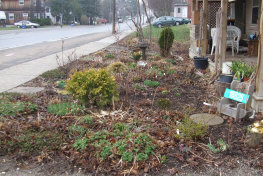
April 2009. What a In my long gardening career I've never seen a spring like the one we're experiencing this year. In hindsight, many of us could have been out there seeding all the cool season vegetable crops and some of the hardy annuals around the beginning or March! Imagine! I have two Witch Hazel's ('Diane' and 'Arnold's Promis' that have been in bloom since March 10th; Primulas, snowdrops, scilla, have been in bloom for at least a couple of weeks now, and the past weekend I drove by some Forsythia in full bloom! Apple trees and tons of other shrubs are already starting to open their buds. At this time they're usually just starting to swell out of dormancy! The problem with being ready for some risk taking? The garden centers aren't ready with any plants! The wholesale / retail side of this industry has many thousands of dollars at stake if they risk bringing plants in early. I can't image that they'll take that risk which means that unless you're planting seed, you may nevertheless need to wait for the regular planting time. What a shame, huh! This will be a year for experimentation and note taking for sure. The downside is that many insect pests may have also had a very easy time overwintering in large numbers successfully, and there's perhaps even time for an additional egg laying cycle. The lack of snow and the extra month of warm weather may cause an early drought season ... There's always a cloud that comes with the silver lining! Cheers! Evelyn
|
||
|
Details of exactly how to prune which shrub is something that comes with experience or a bit of research on the particular plant and how it grows. In a nutshell, pruning is not a straightforward chopping off of the outer branches. That "haircut" type of pruning only weakens the blooming power and ruins branching pattern. Each shrub has it's own growth habit and bloom time that should be taken into consideration and there is always your own, the plant's, or the garden site's, unique reason for pruning in a particular way. Most shrub problems begin and end with incorrect pruning. Aside from removing dead or damaged branches, if in doubt about how and when to prune correctly - don't! The shrub will likely be better off. Take a bit of time to research correct shrub pruning on
the web - there's lots of great information there.
Or, if you can wait a bit, register for the next run of our
in-depth pruning workshop.
Correct shrub pruning is one of the gardening skills to master
if you're ever to achieve a beautiful garden - time spent
learning how to do it correctly will be well worth it. Contact me anytime if your shrubs and small trees
need a bit of experienced TLC. Often just one hour in
March/April and a follow-up hour later in the season is all
that's necessary to keep all your shrubs healthy and looking
great. |
||
 What
does this mean to our gardens?
What
does this mean to our gardens? 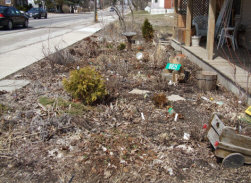
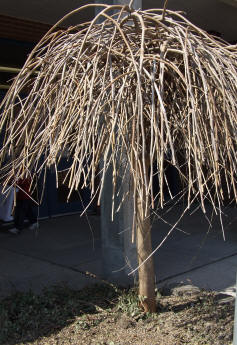 within it's
canopy. It's such a fast growing, weak wooded, plant
that it becomes an impenetrable mess if left for too many
years. The overlapping branches pinch, push and trap one
another, often leading rot and disease. In April weeping
Mulberry can be cut right back to just a dozen or so of the
healthiest branches with great success and can become gorgeous
sculptural plants again. Don't be afraid to cut it right
back to clean it out. It will respond with an explosion
of growth in the first season! They don't leaf out until
May so if you can't get around to it in early April, May is
fine too - just do it!
within it's
canopy. It's such a fast growing, weak wooded, plant
that it becomes an impenetrable mess if left for too many
years. The overlapping branches pinch, push and trap one
another, often leading rot and disease. In April weeping
Mulberry can be cut right back to just a dozen or so of the
healthiest branches with great success and can become gorgeous
sculptural plants again. Don't be afraid to cut it right
back to clean it out. It will respond with an explosion
of growth in the first season! They don't leaf out until
May so if you can't get around to it in early April, May is
fine too - just do it!